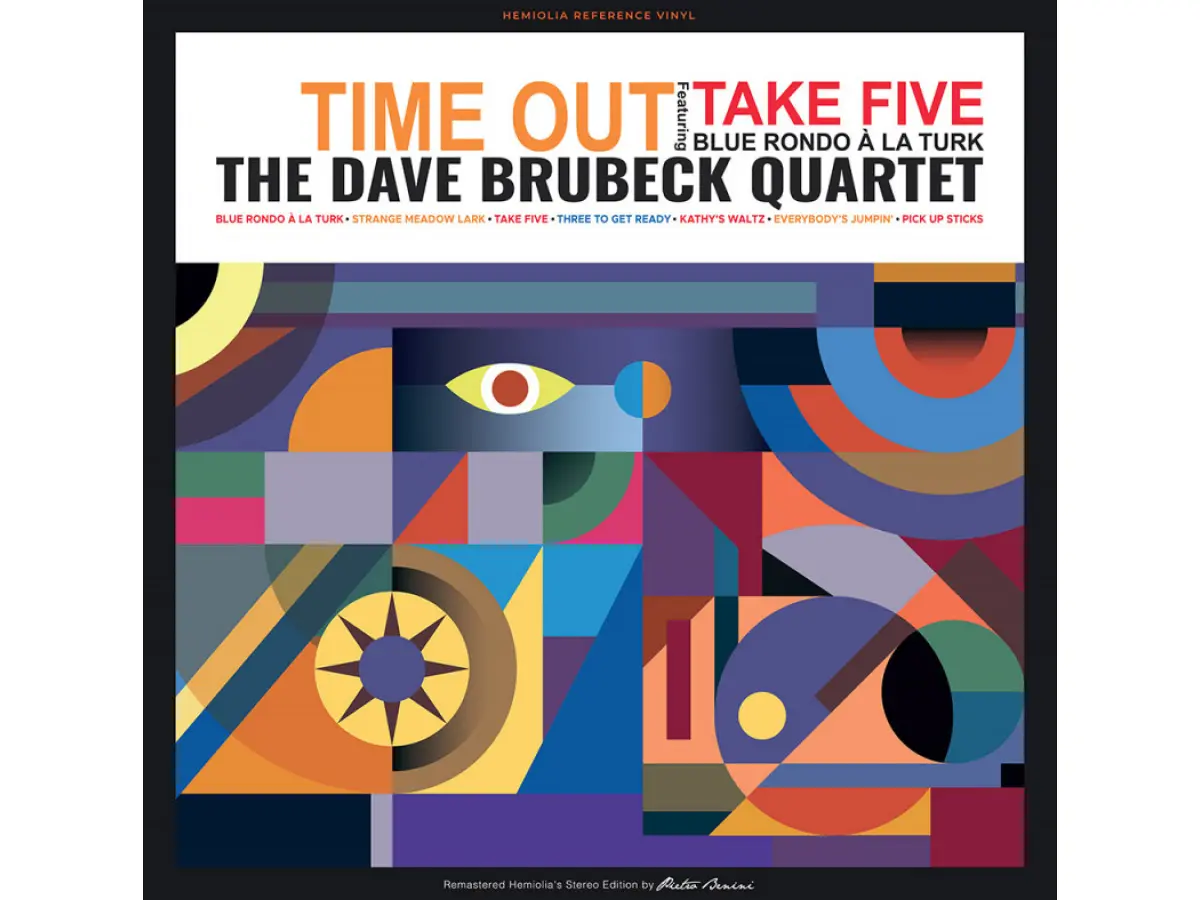
DAVE BRUBECK QUARTET: TIME OUT (LP STEREO ONE - STEP IN EDIZIONE LIMITATA A 1650 COPIE NUMERATE)
Vinyl
Code: 12753376
All our products are covered by Italian warranty.
Performer: The Dave Brubeck Quartet (Dave Brubeck, piano; Paul Desmond, alto saxophone; Eugene Wright, double bass; Joe Morello, drums)
Artist: The Dave Brubeck Quartet
Number of discs: 1
Barcode: 8050616581525
Label: Hemiolia Records
Format: LP
Genre: Jazz
Year: 2026
The second AAA vinyl release from Hemiolia Records is dedicated to a milestone in jazz music: Time Out by the Dave Brubeck Quartet.
All releases in this new series are pressed on 180-gram virgin vinyl and consistently employ One-Step Pressing technology. By eliminating the intermediate stages of traditional electroplating (Father–Mother) and reducing surface noise to the lowest physically achievable level, this process eliminates generational losses between the cutting lacquer and the final stamper, preserving the integrity of the complete sonic information contained on the original tape to the greatest extent possible.
This outstanding result is the culmination of a journey lasting more than two years, involving tests, listening sessions and fine-tuning. It has led to the creation of a truly international team of professionals, each of whom has made a decisive contribution at every stage of the production chain. To ensure maximum consistency, uniformity and sonic stability across all 1,650 copies of the complete pressing run, Hemiolia has established a strict, permanent production protocol:
- Three sets of matching lacquers: To ensure complete consistency between the matrices required to produce the entire limited edition of 1,650 copies, three identical sets of lacquers are made for each side. They are cut consecutively on the same day and drawn from the same carefully selected batch of blank lacquers.
- A strict limit of 550 pressings: Each set of lacquers is used to press 550 copies, reaching the total limit of 1,650 copies for the limited edition. Although industry standards allow substantially higher pressing runs per matrix, Hemiolia has established a mandatory stamper retirement limit after just 550 copies, protecting the groove from mechanical stress and preventing any deterioration in pressing quality within each individual production batch.
- Dual sequential hand numbering: To certify this rigorous process and enhance the collectible value of the release, every copy in the limited series is individually hand-numbered. Each record bears two sequential numbers: one identifies the source lacquer (Lacquer 1, 2 or 3), while the other is the unique serial number of that particular copy within the pressing run.
A collaborative, international undertaking bringing together leading European specialists at every stage of the analogue production chain:
- Mastering (Italy): Pietro Benini, using an Otari MTR-15 tape recorder, a 96-channel D&R Merlin analogue console and reference outboard equipment (Maselec, Tube-Tech, Drawmer and Studer).
- Lacquer Cutting (Germany): Andreas Bauer (AB Mastering), using a Neumann VMS-80 cutting lathe, a Neumann SP-79 console and a Studer A80 MKII playback machine (¼-inch preview playback machine).
- Electroplating (UK): One-Step metal stampers engineered and manufactured by Stamper Discs.
- Pressing (Denmark): RPM Records, using Canadian-made Warmtone presses by Viryl Technologies.
Tracklist
Side A
- Blue Rondo à la Turk
- Strange Meadow Lark
- Take Five
Side B
- Three to Get Ready
- Kathy's Waltz
- Everybody's Jumpin'
- Pick Up Sticks
A Brief History
December 14, 1959, was truly a historic date. On that day, Columbia Records released Time Out, an album recorded by Dave Brubeck on piano with his quartet, featuring Paul Desmond on alto saxophone, Eugene Wright on double bass and Joe Morello on drums. The sessions took place between May 25 and August 18, 1959, at Columbia's 30th Street Studios in New York.
Columbia Records was far from enthusiastic about the results of the recording sessions. It was Irving Townsend, a visionary producer and A&R executive who had just completed the sessions for Kind of Blue, who persuaded the label to support Brubeck's project. This did not prevent contemporary critics from regarding Time Out as a betrayal of jazz. None of this, of course, diminished the album's success: in 1961, the album's signature track, composed by Paul Desmond, climbed to the top of the pop charts. Played in 5/4 time, “Take Five” became the first jazz single to sell more than one million copies.
The album became an essential milestone in the genre. In 2011, it was certified double platinum by the Recording Industry Association of America for sales of two million copies, even though Brubeck and his band had moved away from the traditional 3/4 and 4/4 time signatures to actively explore new musical territory. To put it bluntly, the album really is that good, even if so many people love it!
The Recording
The recording sessions for Time Out took place at Columbia's renowned 30th Street Studio in New York, the same studio used for Kind of Blue and one of the most remarkable recording spaces in jazz history. Housed in a converted Armenian Orthodox church, the studio offered an exceptional volume of air and natural acoustics that played a decisive role in shaping the recording's spatial character.
On Time Out, these acoustic qualities translate into extraordinary sonic clarity. The placement of the instruments in space and the balance between the individual musical voices become structural elements of the listening experience, just as important as the album's rhythmic architecture.
Hemiolia's edition brings out the remarkable tonal character of Time Out and reveals a carefully crafted sound. The balance between the instruments and the precise reconstruction of the soundstage make every detail of this recording immediately perceptible.
With this vinyl reissue, Hemiolia Records goes far beyond a conventional restoration of Time Out. Whereas previously available reissues of Saxophone Colossus on the market were based on copies of the original master tapes, Hemiolia Records gained access to an original, first-generation, flat ¼-inch production master tape. This allowed the label to create a unique reinterpretation of the original material, free from the usual sound-quality alterations.
Pietro Benini's remastering approaches Time Out with the utmost respect, allowing this magnificent work to breathe within a wider, deeper soundstage without distorting the original sonic character or dynamics of the recording.
Potrebbe interessarti anche
